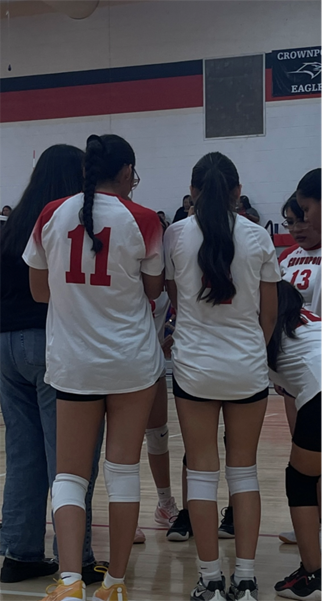

At Crownpoint High School, the goal of improving in volleyball is demonstrated through the growth of students like Courtney Craig. Over time, she has developed not only as an athlete but also as a student, showing how dedication to both academics and volleyball can lead to success. With guidance from experienced coaches and consistent training, players continue to strengthen their skills, discipline, and understanding of the game. This growth reflects how hard work in both the classroom and on the court helps shape well-rounded and successful student-athletes.
When Crownpoint High School changed coaches, Coach Abby emphasized that success in volleyball requires discipline. She made it clear that if players want to become better athletes, they must be willing to put in the time and effort.
Coach Abby explained, “I would tell the players that if they truly want to improve in the sport they love, it takes time, dedication, and energy to overcome challenges and reach their goals.” This shows that volleyball is not just about playing—it also requires commitment and hard work. Students who want to improve must focus on developing their basic skills and pushing themselves beyond their limits.
Courtney Craig also shared her experience, stating, “I would improve myself by training during the off-season and joining a volleyball club called Starlings 505. Even when it was not volleyball season, I still trained and focused on volleyball because it is my favorite sport.” This shows her dedication to improving by practicing on her own time and gaining additional experience.
The foundation of volleyball begins with mastering basic skills such as serving, passing, setting, and hitting. Serving starts each rally and requires accuracy and consistency. Passing, often using a forearm pass, allows players to control the ball and set up an attack. Setting positions the ball for a hitter, while hitting focuses on timing and proper arm swing to score points. Learning these skills builds confidence and prepares players for game situations.
Understanding the basic rules and player positions is also essential. Each team has six players on the court, rotating positions after winning a serve. Players must know when to rotate, avoid faults such as double hits or net violations, and follow scoring rules. Knowing positions—such as setter, hitter, and libero—helps players understand their roles and work effectively as a team.
Volleyball is a team sport that relies heavily on communication and cooperation. Players must call for the ball, support each other, and move together on the court. Strong teamwork helps prevent errors, improves ball control, and creates better offensive opportunities. Effective communication builds trust and leads to stronger overall performance.
Basic volleyball skills are essential for success because they provide the foundation for more advanced techniques and strategies. Skills such as serving, passing, setting, hitting, and teamwork help players develop coordination, improve communication, and build confidence. Without mastering these fundamentals, it is difficult to perform consistently or improve as a player.
In conclusion, learning and practicing the basic skills of volleyball is important not only for individual development but also for building strong, effective teams and a deeper appreciation of the sport. As athletes progress to advanced high school volleyball, these basic skills are combined with greater speed, strategy, and mental toughness. At this level, players use advanced techniques, complex systems, and precise communication to compete at a high level. Ultimately, mastering the fundamentals while continuing to develop advanced skills prepares players for higher levels of competition and long-term success in volleyball.